


Page 92 - Dignity and justice for all of us our voices are heard in Thailand
P. 92
Universal Declaration of Human Rights


                                        Voice


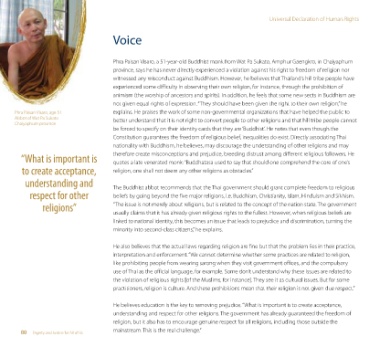
                                        Phra Paisan Visaro, a 51-year-old Buddhist monk from Wat Pa Sukato, Amphur Gaengkro, in Chaiyaphum
                                        province, says he has never directly experienced a violation against his right to freedom of religion nor
                                        witnessed any misconduct against Buddhism. However, he believes that Thailand’s hill tribe people have
                                        experienced some difficulty in observing their own religion, for instance, through the prohibition of
                                        animism (the worship of ancestors and spirits). In addition, he feels that some new sects in Buddhism are
                                        not given equal rights of expression. “They should have been given the right to their own religion,” he

      Phra Paisan Visaro, age 51        explains. He praises the work of some non-governmental organizations that have helped the public to
      Abbot of Wat Pa Sukato            better understand that it is not right to convert people to other religions and that hill tribe people cannot
      Chaiyaphum province
                                        be forced to specify on their identity cards that they are ‘Buddhist’. He notes that even though the
                                        Constitution guarantees the freedom of religious belief, inequalities do exist. Directly associating Thai
                                        nationality with Buddhism, he believes, may discourage the understanding of other religions and may
        “What is important is           therefore create misconceptions and prejudice, breeding distrust among different religious followers. He
                                        quotes a late venerated monk: “Buddhatasa used to say that should one comprehend the core of one’s
         to create acceptance,          religion, one shall not deem any other religions as obstacles.”

          understanding and               The Buddhist abbot recommends that the Thai government should grant complete freedom to religious
           respect for other            beliefs by going beyond the five major religions, i.e. Buddhism, Christianity, Islam, Hinduism and Sikhism.

                religions”              “The issue is not merely about religions, but is related to the concept of the nation state. The government
                                        usually claims that it has already given religious rights to the fullest. However, when religious beliefs are
                                        linked to national identity, this becomes an issue that leads to prejudice and discrimination, turning the
                                        minority into second-class citizens,” he explains.

                                        He also believes that the actual laws regarding religion are fine but that the problem lies in their practice,
                                        interpretation and enforcement. “We cannot determine whether some practices are related to religion,
                                        like prohibiting people from wearing sarong when they visit government offices, and the compulsory
                                        use of Thai as the official language, for example. Some don’t understand why these issues are related to
                                        the violation of religious rights [of the Muslims, for instance]. They see it as cultural issues. But for some
                                        practitioners, religion is culture. And these prohibitions mean that their religion is not given due respect.”

                                        He believes education is the key to removing prejudice. “What is important is to create acceptance,
                                        understanding and respect for other religions. The government has already guaranteed the freedom of
                                        religion, but it also has to encourage genuine respect for all religions, including those outside the

        80  Dignity and Justice for All of Us  mainstream. This is the real challenge.”

