


Page 88 - Dignity and justice for all of us our voices are heard in Thailand
P. 88
Universal Declaration of Human Rights


                                        Voice


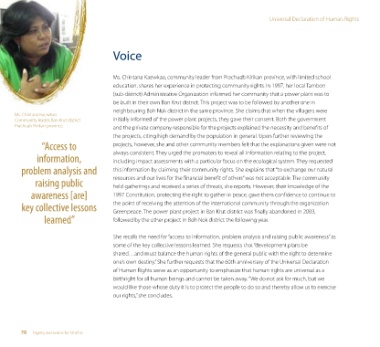
                                        Ms. Chintana Kaewkao, community leader from Prachuab Kirikan province, with limited school
                                        education, shares her experience in protecting community rights. In 1997, her local Tambon
                                        (sub-district) Administrative Organization informed her community that a power plant was to
                                        be built in their own Ban Krut district. This project was to be followed by another one in
                                        neighbouring Boh Nok district in the same province. She claims that when the villagers were
      Ms. Chintana Kaewkao
      Community leader, Ban Krut district   initially informed of the power plant projects, they gave their consent. Both the government
      Prachuab Kirikan province         and the private company responsible for the projects explained the necessity and benefits of
                                        the projects, citing high demand by the population in general. Upon further reviewing the
               “Access to               projects, however, she and other community members felt that the explanations given were not
              information,              always consistent. They urged the promoters to reveal all information relating to the project,
                                        including impact assessments with a particular focus on the ecological system. They requested
        problem analysis and            this information by claiming their community rights. She explains that “to exchange our natural

             raising public             resources and our lives for the financial benefit of others” was not acceptable. The community
                                        held gatherings and received a series of threats, she reports. However, their knowledge of the
            awareness [are]             1997 Constitution, protecting the right to gather in peace, gave them confidence to continue to

        key collective lessons          the point of receiving the attention of the international community through the organization
                                        Greenpeace. The power plant project in Ban Krut district was finally abandoned in 2003,
                learned”                followed by the other project in Boh Nok district the following year.

                                        She recalls the need for “access to information, problem analysis and raising public awareness” as
                                        some of the key collective lessons learned. She requests that “development plans be
                                        shared…and must balance the human rights of the general public with the right to determine
                                        one’s own destiny.” She further requests that the 60th anniversary of the Universal Declaration
                                        of Human Rights serve as an opportunity to emphasize that human rights are universal as a
                                        birthright for all human beings and cannot be taken away. “We do not ask for much, but we
                                        would like those whose duty it is to protect the people to do so and thereby allow us to exercise
                                        our rights,” she concludes.


        76  Dignity and Justice for All of Us

