


Page 94 - Dignity and justice for all of us our voices are heard in Thailand
P. 94
Universal Declaration of Human Rights


                                        Voice


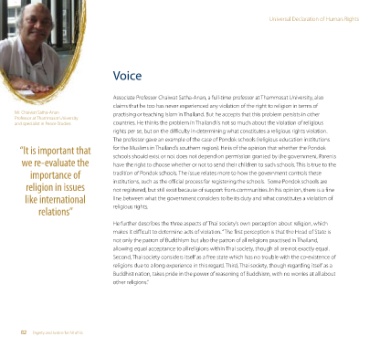
                                        Associate Professor Chaiwat Satha-Anan, a full-time professor at Thammasat University, also
                                        claims that he too has never experienced any violation of the right to religion in terms of
      Mr. Chaiwat Satha-Anan            practising or teaching Islam in Thailand. But he accepts that this problem persists in other
      Professor at Thammasat University
      and specialist in Peace Studies   countries. He thinks the problem in Thailand is not so much about the violation of religious
                                        rights per se, but on the difficulty in determining what constitutes a religious rights violation.
                                        The professor gave an example of the case of Pondok schools (religious education institutions
        “It is important that           for the Muslims in Thailand’s southern region). He is of the opinion that whether the Pondok
        we re-evaluate the              schools should exist or not does not depend on permission granted by the government. Parents
                                        have the right to choose whether or not to send their children to such schools. This is true to the
           importance of                tradition of Pondok schools. The issue relates more to how the government controls these

          religion in issues            institutions, such as the official process for registering the schools.  Some Pondok schools are
                                        not registered, but still exist because of support from communities. In his opinion, there is a fine
          like international            line between what the government considers to be its duty and what constitutes a violation of

              relations”                religious rights.

                                        He further describes the three aspects of Thai society’s own perception about religion, which
                                        makes it difficult to determine acts of violation. “The first perception is that the Head of State is
                                        not only the patron of Buddhism but also the patron of all religions practised in Thailand,
                                        allowing equal acceptance to all religions within Thai society, though all are not exactly equal.
                                        Second, Thai society considers itself as a free state which has no trouble with the co-existence of
                                        religions due to a long experience in this regard. Third, Thai society, though regarding itself as a
                                        Buddhist nation, takes pride in the power of reasoning of Buddhism, with no worries at all about
                                        other religions.”


        82  Dignity and Justice for All of Us

