


Page 136 - Dignity and justice for all of us our voices are heard in Thailand
P. 136
Universal Declaration of Human Rights


                                        “Knowledge about human rights should start

                                        during our childhood, as part of our culture”


                                        Voice


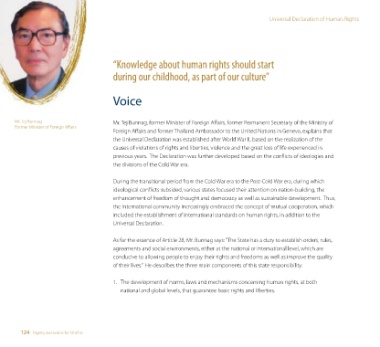
      Mr. Tej Bunnag                    Mr. Tej Bunnag, former Minister of Foreign Affairs, former Permanent Secretary of the Ministry of
      Former Minister of Foreign Affairs
                                        Foreign Affairs and former Thailand Ambassador to the United Nations in Geneva, explains that
                                        the Universal Declaration was established after World War II, based on the realization of the
                                        causes of violations of rights and liberties, violence and the great loss of life experienced in
                                        previous years.  The Declaration was further developed based on the conflicts of ideologies and
                                        the divisions of the Cold War era.


                                        During the transitional period from the Cold War era to the Post-Cold War era, during which
                                        ideological conflicts subsided, various states focused their attention on nation-building, the
                                        enhancement of freedom of thought and democracy as well as sustainable development.  Thus,
                                        the international community increasingly embraced the concept of mutual cooperation, which
                                        included the establishment of international standards on human rights, in addition to the
                                        Universal Declaration.


                                        As for the essence of Article 28, Mr. Bunnag says: “The State has a duty to establish orders, rules,
                                        agreements and social environments, either at the national or international level, which are
                                        conducive to allowing people to enjoy their rights and freedoms as well as improve the quality
                                        of their lives.”  He describes the three main components of this state responsibility:

                                        1.  The development of norms, laws and mechanisms concerning human rights, at both
                                           national and global levels, that guarantee basic rights and liberties.


        124 Dignity and Justice for All of Us

