


Page 116 - Dignity and justice for all of us our voices are heard in Thailand
P. 116
Universal Declaration of Human Rights


                                        Voice


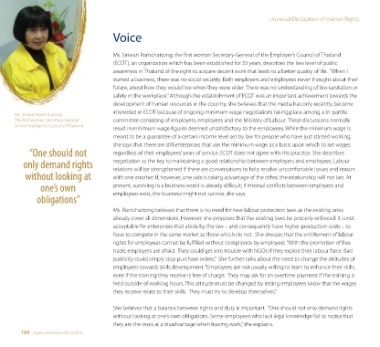
                                        Ms. Siriwan Romchattong, the first woman Secretary-General of the Employer’s Council of Thailand
                                        (ECOT), an organization which has been established for 33 years, describes the low level of public
                                        awareness in Thailand of the right to acquire decent work that leads to a better quality of life.  “When I
                                        started a business, there was no social security. Both employers and employees never thought about their
                                        future, about how they would live when they were older. There was no understanding of bio-sanitation or
                                        safety in the workplace.” Although the establishment of ECOT was an important achievement towards the
                                        development of human resources in the country, she believes that the media has only recently become
                                        interested in ECOT because of ongoing minimum wage negotiations taking place among a tri-partite
      Ms. Siriwan Romchattong
      The first woman Secretary-General    committee consisting of employers, employees and the Ministry of Labour. These discussions normally
      of the Employer’s Council of Thailand
                                        result in minimum wage figures deemed unsatisfactory to the employees. While the minimum wage is
                                        meant to be a guarantee of a certain income level set by law for people who have just started working,
                                        she says that there are still enterprises that use the minimum wage as a basis upon which to set wages
           “One should not              regardless of their employees’ years of service. ECOT does not agree with this practice. She describes

         only demand rights             negotiation as the key to maintaining a good relationship between employers and employees. Labour
                                        relations will be strengthened if there are conversations to help resolve uncomfortable issues and reason
          without looking at            with one another. If, however, one side is taking advantage of the other, the relationship will not last. At
               one’s own                present, surviving in a business world is already difficult; if internal conflicts between employers and
              obligations”              employees exist, the business might not survive, she says.

                                        Ms. Romchattong believes that there is no need for new labour protection laws as the existing ones
                                        already cover all dimensions. However, she proposes that the existing laws be properly enforced. It is not
                                        acceptable for enterprises that abide by the law – and consequently have higher production costs – to
                                        have to compete in the same market as those which do not.  She stresses that the entitlement of labour
                                        rights for employees cannot be fulfilled without compliance by employers. “With the promotion of free
                                        trade, employers are afraid.  They could get into trouble with NGOs if they exploit their labour force. Bad
                                        publicity could simply stop purchase orders.”  She further talks about the need to change the attitudes of
                                        employees towards skills development. “Employees are not usually willing to learn to enhance their skills,
                                        even if the training they receive is free of charge.  They may ask for an overtime payment if the training is
                                        held outside of working hours. This attitude must be changed by letting employees know that the wages
                                        they receive relate to their skills.  They must try to develop themselves.”

                                        She believes that a balance between rights and duty is important.  “One should not only demand rights
                                        without looking at one’s own obligations. Some employees who lack legal knowledge fail to notice that
                                        they are the ones at a disadvantage when leaving work,” she explains.
        104 Dignity and Justice for All of Us

